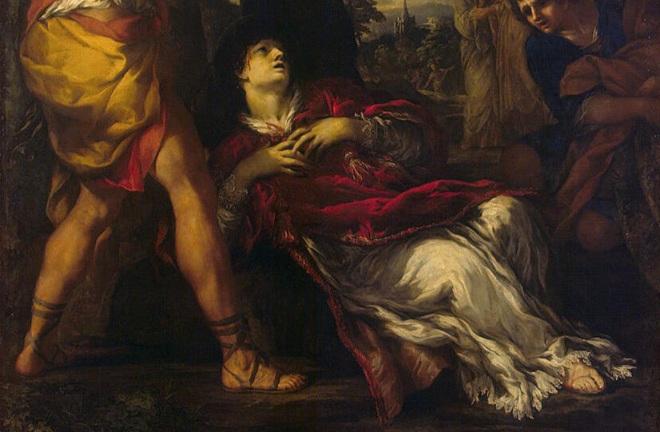
In Italia oggi si celebra Santo Stefano in commemorazione del primo martire cristiano.
Poco si sa della sua infanzia. È menzionato nel sesto capitolo degli Atti degli Apostoli come uno dei sette diaconi della Chiesa di Gerusalemme, il cui compito era quello di prendersi cura dei poveri. I suoi insegnamenti però fecero adirare i membri di varie sinagoghe, quindi fu accusato di blasfemia e poi lapidato a morte nel 34 o 36 d.C.
Al suo martirio assistette fu Saulo di Tarso, detto anche Paolo.
Essendo stato ucciso con la lapidazione, la pietra è il suo principale attributo iconografico.
Una pietra compare anche in una bellissima leggenda a lui collegata, di cui ho già parlato anni fa.
La madre di Stefano, una giovane sposa di nome Tecia, era andata ad adorare Gesù Bambino insieme ad altre donne. Tutte avevano portato i loro figli perché la benedizione del Signore scendesse su di loro. Ma la ragazza non aveva ancora figli, sebbene ne desiderasse ardentemente uno.
Però voleva sembrare anche lei una madre in mezzo a quel gruppo di madri, allora prese una grossa pietra, se la mise tra le braccia avvolta in uno scialle, per farla sembrare un bambino.
Mary lesse nel suo cuore, comprese il suo innocente inganno e le disse che il suo desiderio di avere un figlio si sarebbe avverato. Con grande sorpresa della donna, la pietra che teneva tra le braccia divenne calda e morbida: si era trasformata in un bambino vero.
Tuttavia, Maria le predisse che suo figlio, nato da una pietra, sarebbe morto colpito da pietre.
il nostro amico Joseph, autore del blog manningtreearchive.com ci ha inviato questo prezioso e informativo commento e vorrei condividerlo con tutti voi:
“Il tuo post mi ha ricordato la storia della vita di Santo Stefano e alcune tradizioni correlate di cui avevo letto molto tempo fa. Santo Stefano essendo uno dei sette scelti dagli apostoli per gestire le finanze e le elemosine della chiesa primitiva, il suo dovere includeva anche l’insegnamento. Di conseguenza, fu processato dal Sinedrio per blasfemia e divenne il primo martire cristiano, “il protomartire” come viene chiamato.
La leggenda della pietra legata alla madre del Santo e alla Natività, di cui non ero a conoscenza, potrebbe essere collegata al periodo di Santa Eudocia (imperatrice Aelia Eudocia, moglie di Teodosio II). Eudocia fu sepolta nella chiesa di Santo Stefano che fu costruita da lei a Gerusalemme. Questa leggenda di Tecia potrebbe aver avuto origine durante quel periodo, probabilmente a causa della scoperta delle reliquie di Santo Stefano in un sarcofago di legno da parte di Luciano, sacerdote di Capharmajala, e Giovanni, patriarca di Gerusalemme nel dicembre del 415 d.C. Inoltre, nelle Costituzioni Apostoliche, un’opera della fine del II o III secolo, viene menzionata la festa di Santo Stefano, ma non quella della Natività, perché la commemorazione della nascita di Cristo fu di istituzione successiva. Fu nel IV secolo che San Gregorio di Nissa unì la festa di Santo Stefano a quella della Natività.
È interessante notare che una vecchia pubblicazione afferma di un’altra tradizione che fa di Santo Stefano il ragazzo che timidamente porta il suo pranzo, “cinque pani d’orzo e due piccoli pesci”, al Signore della collina verde vicino alla Galilea. Ciò portò alla miracolosa alimentazione di 5.000 persone.”

In Italy today we celebrate Saint Stephen‘s day to commemorate the first Christian martyr.
Little is known about his early life. He is mentioned in the sixth chapter of the Acts of the Apostles as one of seven deacons in the early Church at Jerusalem, whose task was to take care of the poor. His teachings, however, angered members of various synagogues, so he was accused of blasphemy and then stoned to death in 34 or 36 AD.
His martyrdom was witnessed and participated by Saul of Tarsus, also known as Paul.
Having been killed by stoning, the stone is his main iconographical attribute.
A stone also appears in a beautiful legend connected to him.
Stephen’s mother, a young bride named Tecia, went to adore the Child Jesus together with other women. All of them had brought their children for Jesus to bless them. But the girl still had no children, although she longed for one.
But she too wanted to appear as a mother in the midst of that group of mothers, so she took a large stone, placed it in her arms wrapped in a shawl, to make it look like a baby.
Mary read into her heart, understood her innocent deception, and told her that her desire to have a child would come true. To the woman’s surprise, the stone she held in her arms became warm and soft: it had been transformed into a real baby.
However, Maria predicted that her son, born of a stone, would die struck by stones.
Our friend Joseph , author of the blog manningtreearchive.com sent this valuable and informative comment and I would like to share it with all of you:
“Your post reminded me of St. Stephen’s life story and some related traditions about which I had read a long time ago. St. Stephen being one of the seven chosen by the apostles to manage the finance and alms of the early church, his duty also included teaching. As a consequence, he was tried by the Sanhedrin for blasphemy and became the first Christian martyr – “the protomartyr” as he is called.
The legend of stone related to the Saint’s mother and the Nativity, of which I was not aware of, could be connected to the period of Saint Eudocia (Empress Aelia Eudocia, wife of Theodosius II). Eudocia was buried in the Church of St. Stephen which was built by her in Jerusalem. This legend of Tecia might have originated during that period probably due to the discovery of the relics of St. Stephen in a wooden sarcophagus by Lucian, priest of Capharmajala, and John, patriarch of Jerusalem in December A.D. 415. Besides, in the Apostolic Constitutions, a work of the end of the 2nd or 3rd century, the festival of St. Stephen is mentioned, but not that of the Nativity, because the commemoration of the birth of Christ was of later institution. It was in the 4th century that St. Gregory of Nyssa united the feast of St. Stephen with that of the Nativity.
Interestingly, an old publication states of another tradition which makes St. Stephen the lad who shyly brings his lunch, “five barley loaves and two small fishes”, to the Lord of the green hill by Galilee. This led to the miraculous feeding of 5,000. “
[ BlogLink : Words and Music and Stories ]






 MasticadoresItalia
Scrivi una risposta a Adarsh G Cancella risposta