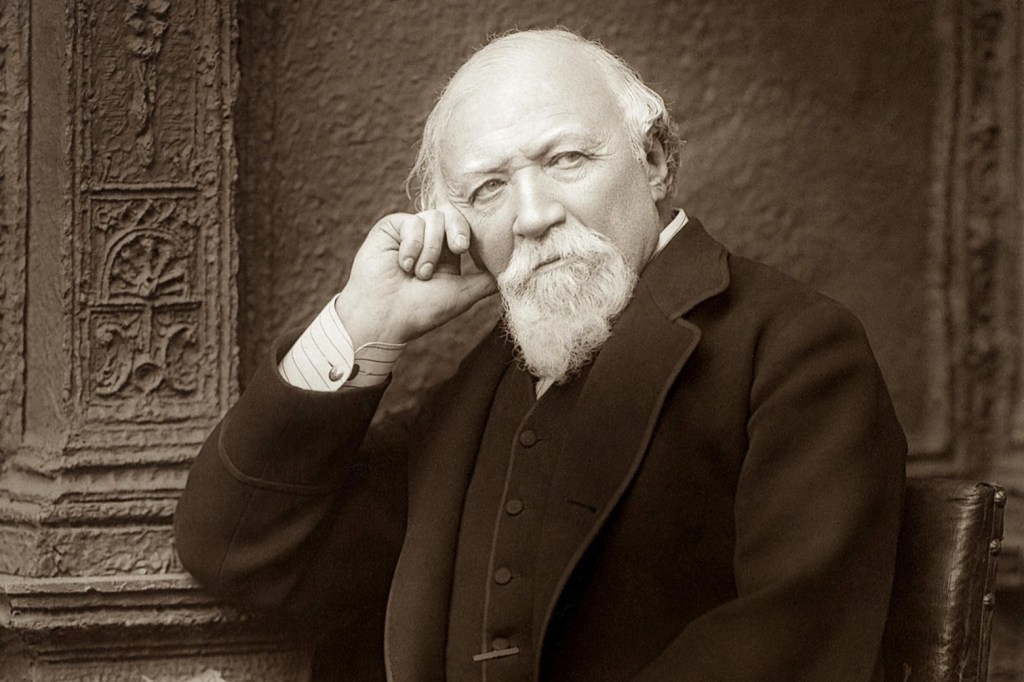
Il poeta e drammaturgo inglese Robert Browning nacque il 7 maggio 1812.
Fu uno dei più importanti poeti vittoriani, famoso per la sua maestria nella poesia drammatica, in particolare nei monologhi drammatici.
Quando sposò la poetessa Elizabeth Barrett, nel 1846, la coppia si trasferì in Italia, prima a Pisa e poi a Firenze, dove rimase fino alla morte di Elizabeth.
In Italia ebbero il loro unico figlio, Robert Wiedemann Barrett Browning, che sarebbe poi diventato un pittore. *Il bambino era soprannominato “Pen”, secondo Elizabeth perchè, nel tentativo di pronunciare Wiedeman (cognome da nubile della nonna paterna) lo trasformò “in Peninny, con una straordinaria risoluzione di sillabe” (lettera ad Arabella, [12-14 ottobre 1851]). Il nome Penniny, o più sovente Penini, fu abbreviato dapprima in Peni e successivamente in “Pen”. Anni dopo, la spiegazione del soprannome “Pen” fu riportata da William Lyon Phelps: “Quando era bambino, balbettava… e nel tentativo di pronunciare ‘Nini’, il nome che gli italiani [i fiorentini] danno ai loro figli, diceva ‘Pnnn-nini’” (WL Phelps, “Robert Browning visto da suo figlio”, The Century Magazine , gennaio 1913, p. 419).
Adesso
Di tutta la tua vita, dammi solo un attimo!
Di tutta la vita che è venuta prima
e quella che verrà dopo e che quindi ignori
Perciò rendi perfetto il presente, condensa
in un’ondata di ardore, dono di perfezione,
pensiero e sensazioni, anima e sensi.
Fusi in quell’attimo che finalmente per una volta
mi dona te intorno a me, sotto di me, sopra di me –
e mi rende certo che, nonostante il tempo futuro e quello passato,
in questo attimo fugace della vita tu ami me!
Quanto tempo può durare questa sospensione? Ah, Amore,
l’attimo eterno – solo quello e nient’altro –
Quando l’estasi è al culmine, ci aggrappiamo alla sua essenza,
mentre le guance bruciano, le braccia si aprono, gli occhi si chiudono e le labbra si incontrano!
[ Traduzione di Luisa Zambrotta ]
In questi versi molto intensi, Robert Browning esprime splendidamente il suo desiderio di unione perfetta con la moglie Elizabeth.
Consapevole che l’amore ideale può esistere solo per un attimo fugace, cerca di isolare questo stato di perfezione: un momento in grado di dargli però un senso duraturo nella sua vita.
L’uso del linguaggio temporale (tempo, momento, presente, passato, futuro…) crea un campo lessicale del tempo, ricordando all’amante e al lettore che il tempo è finito ed è sempre necessario cogliere l’attimo (carpe diem).

English poet and playwright Robert Browning was born on 7 May 1812.
He was one of the foremost Victorian poets, famous for his mastery of dramatic verse, especially dramatic monologues.
When he married poet Elizabeth Barrett, in 1846 the couple came to Italy first in Pisa and then in Florence, until Elizabeth’s death,
In Italy they had their only child Robert Wiedemann Barrett Browning, who was to become a painter. *The child was nicknamed “Pen,” according to Elizabeth because, in attempting to pronounce Wiedeman (after his paternal grandmother’s maiden name), he transformed it “into Peninny, with extraordinary resolution of syllables” (letter to Arabella, [October 12-14, 1851]). The name Penniny, or more often Penini, was shortened to Peni and finally to “Pen.” Years later, the explanation for the nickname “Pen” was reported by William Lyon Phelps: “When a child, he stammered . . . and in attempting to pronounce ‘Nini,’ the name the Italians [Florentines] give to their children, he said ‘Pnnn-nini.’” (W. L. Phelps, “Robert Browning as Seen by His Son,” The Century Magazine, January 1913, p. 419).
Now
Out of your whole life give but a moment!
All of your life that has gone before,
All to come after it, – so you ignore,
So you make perfect the present, condense,
In a rapture of rage, for perfection’s endowment,
Thought and feeling and soul and sense,
Merged in a moment which gives me at last
You around me for once, you beneath me, above me –
Me, sure that, despite of time future, time past,
This tick of life-time’s one moment you love me!
How long such suspension may linger? Ah, Sweet,
The moment eternal – just that and no more –
When ecstasy’s utmost we clutch at the core,
While cheeks burn, arms open, eyes shut, and lips meet
In these very intense lines Robert Browning beautifully expresses his desire for a perfect union with his wife Elizabeth.
Aware that ideal love can only exist for a fleeting moment he attempts to isolate that very special state of perfection : that moment gives him a sense of something lasting in his life.
The use of temporal language (time, moment, present, past, future…) creates a lexical field of time, reminding the lover and the reader that time is finite and it is always necessary to seize the moment (carpe diem).
[ SiteLink : Words and Music and Stories ]
*Source/Fonte: The Browning’s Correspondence




 MasticadoresItalia
Lascia un commento